
To the Fourth Power — The Spiritual Skeptic

…to the 4th Power

The Spiritual Skeptic

 “For My thoughts are not your thoughts, neither are your ways My ways, declares the Lord. For as the heavens are higher than the earth, so are My ways higher than your ways and My thoughts than your thoughts.” Isaiah 55:8-9 (ESV)

“God doesn’t me to have fun!”

“All roads lead to heaven.”

“When I die I wanna come back as a blade of grass”

“I mediate in order to connect with my inner self”

faith_and_the_skeptic

These are some of the statements made by folks who can be spiritually misguided. Their thoughts on what is God like, how other religions are, what’s in the afterlife or the supernatural can be rather shocking to the born-again believer. I myself always make the joke about how I would like to come back as a lawn mower so that I may mow over those who want to come back as a field of grass or flowers. But if we are to defend the faith these kinda jokes don’t help the cause of The Cross. It certainly isn’t what Jesus would do.

In the workbook that goes along with his book “Meet The Skeptic” Bill Foster gives his thought on what the root of the problem is. “Good works get you into heaven. All religions and spiritual beliefs other than Christianity have this works-based Root idea in common. This reflects the worldview of Spirituality. People want to get into heaven by using their own power. However, we will see that spirituality is self-defeating because it relies on trusting one’s own flawed works as the way to reach a perfect place.” Guess that means that Nirvana is just a name for hand cream?

The founder of “The Church of Scientology”, L. Ron Hubbard made this statement, “For countless ages, a goal of religion has been the salvage of the human spirit. Man has tried by many practices to find the pathway to salvation. He has held the imperishable hope that someday in some way he would be free.” This is true in the sense that man wants to reach a place that’s better than this one but, c’mon let’s face it…Jesus Christ is The Way, The Truth and The Life. Our stairway to heaven starts with Him!!

In Ecclesiastes 3:11 we read, “He has made everything beautiful in its time. Also, He has put eternity into man’s heart, yet so that he cannot find out what God has done from the beginning to the end.” This would be that YHVH has already placed within us that a reality exists beyond this ball of chaos and disorder. The key difference for Christianity versus other faiths is the fruits of the Spirit. Good works may give honor to whatever deity they believe in but our display of the fruits of the Spirit is our response for God having reached us.

The question to ask here is “How good is good enough?” If heaven was to be populated with the “Basically Good” we could call that place “Disney World” (there’s a stretch for ya).  Basically good could get us into medical school, quarterbacking for the Eagles, pitching for the Phillies (I’m taking this too far ain’t I?) or working for Apple computer. But why would a basically good person be allowed to be in the presence of a perfect God and be allowed to stay in a perfect place, forever? Hmmm…basically it goes like this, we are not saved by good works, it’s by grace, through faith in God’s perfect Son, Jesus Christ. – Chris Hughes blogs weekly for Freedom Fighter and is a graduate of the Colony of Mercy

Daily Bible Reading: Psalm 37-39; Acts 17:16-34

Quote of the day: “Obeying the Ten Commandments and displaying the fruits of the Spirit are not formulas for reaching God, but are instead responses to God having reached us.”—Bill Foster Verse to Memorize: Your promise is well tried and your servant loves it. I am small and despised, yet I do not forget your precepts. Psalm 119:140-141 ESV


 

Pursuing Our Destiny — The Discipline of Frugality

Pursuing Our Destiny, Part 10—The Discipline of Frugality

Not that I am speaking of being in need, for I have learned in whatever situation I am to be content.  I know how to be brought low, and I know how to abound.  In any and every circumstance, I have learned the secret of plenty and hunger, abundance and need (Philippians 4:11&12, ESV).

So far in this series of Wednesday posts, we’ve considered several abstinence disciplines: solitude, silence, and fasting.  I invite you to think with me this week about another abstinence discipline: frugality.  In our American culture of bigger is better and more is better, many of us need this practice in our lives.

frugality_saving_money_while_shopping-300x300

Here is a good working definition of frugality that comes from author Ken Boa: The discipline of frugality refers to a willingness to abstain from the use of our resources for our own gratification and aggrandizement.  A mindset of frugality/simplicity helps us resist the cultural endorsement of extravagance and consumption that entices us away from gratitude, trust, and dependence upon the Lord. 

As I read Boa’s definition, I’m reminded of the Apostle Paul’s words in Colossians 3:1&2: If then you have been raised with Christ, seek the things that are above, where Christ is, seated at the right had of God.  Set your minds on things that are above, not on things that are on the earth.  For you have died, and your life is hidden with Christ in God.

Both Boa’s definition and Paul’s admonition speak to the issue of focus and attachment.  The primary intent behind the discipline of frugality—beyond our desire to be conformed to the image of our Savior—is simply to avoid becoming over-attached to a world that is not our home.  Many of us who will read this piece live in relative affluence.  While we’re not rich (although almost everyone in the “two-thirds world” would consider the poorest of us rich), many of us have more than we need.  Because that’s true, we face the danger of neglecting Paul’s instruction in Romans 12:2: Don’t become so well-adjusted to  your culture that you fit into it without even thinking (The Message).

Lest I be misunderstood, let me tell you what frugality isn’t.  Frugality is not stinginess. It is not penny-pinching. It isn’t becoming a miser.  Frugality is not buying only sale items and it isn’t wearing suits or dresses until they wear out.  It isn’t always shopping at discount or second-hand stores.  On the contrary, frugality is choosing to think about our resources and possessions in the context of Jesus’ teaching in Mt. 6:19-24 (Please take time to read this passage!).

In the words of Dallas Willard, In frugality we abstain from using money or goods at our disposal in ways that merely gratify our desires or our hunger for status, glamour, or luxury.  Practicing frugality means we stay within the bounds of what general good judgment would designate as necessary for the kind of life to which God has led us.

The discipline of frugality protects us from self-indulgence, from an unhealthy attachment to the world, and keeps us focused on that which is eternal.  We can begin a life of frugality by asking three questions before we invest our resources.  (1.) Have I prayed before I pay?  (2.) Do I really need what I’m about to pay for, and could I do with a similar but less expensive product?  (3.) What is my motivation for this purchase—need or want, legitimate purpose or pleasure, to honor God and my family or to impress others—and have I brought that motivation before the Lord?

I invite you to join me in thinking about frugality and how God might want to use it in our lives. – Pastor John Strain blogs weekly and is available for pulpit supply. He recently retired from First Baptist of Toms River

Daily Bible Reading: Psalm 35-36; Acts 17:1-5

Quote of the day: The ministry of prayer, if it be anything worthy of the name, is a ministry of ardor, a ministry of unwearied and intense longing after God and after his holiness. (E. M.) Bounds

Verse to Memorize: Your promise is well tried and your servant loves it. I am small and despised, yet I do not forget your precepts. Psalm 119:140-141 ESV

 

Enemies to Allies

Enemies to Allies

1 Samuel 17:45-   1 Samuel 27:1-  2 Samuel 15:18

David first comes on the scene when he’s called on to fight Goliath—the Philistine giant. From the moment he steps into the picture, David makes it clear who his God is and where his confidence is placed. Not only does David defeat Goliath, Israel chases the Philistine armies all the way back to Gath.

Allies-150x150

Time passes and David finds himself fleeing from Saul. Where does David flee to? To the land of the Philistines and the city of Gath! For 16 months, David, 600 men of his army and their families, live and fight alongside the armies and for the very king, Achish, who’s hero and armies he had defeated. To the casual onlooker, this would seem ridiculous. But to God, it’s all part of a greater plan to glorify Himself.

More time passes and David is King of all the Jewish nations. But trouble is upon him and it’s the worse time in all of David’s reign as King. Absalom is ready to overthrow his father and take the throne as king. David is at the city gates reviewing those who would flee with him when Ittai the Gittite and his 600 armies and their families come to pass. (That’s Ittai the Philistine commander from Gath) David stops him and basically gives him a blessing with the OK to go back to the city. What Ittai says is amazing—“by God I will follow the king weather for life or for death!” (paraphrased)  HOW DOES THIS HAPPEN?  How does a sworn enemy become an ally—even unto death?

Through David’s testimony—that’s how. From his first fight against Goliath through his time in exile and his reign as king over Israel, David had such a powerful testimony of his faith and love of God, it actually “converted” his enemies.

This is a very heavy concept to consider—is my testimony powerful enough to attract my “enemies” to Christ? Does my faith glorify Christ in all that I do? Who are my “Philistines”? – Steve Schmidt is a graduate of the Colony of Mercy and serves full-time at America’s Keswick

Daily Bible Reading: Psalm 33-34; Acts 16:22-40

Quote of the day: Do not waste your time bothering whether you “love” your neighbour act as if you did. As soon as we do this, we find one of the great secrets. When you are behaving as if you loved someone, you will presently come to love him. If you injure someone you dislike, you will find yourself disliking him more. If you do him a good turn, you will find yourself disliking him less. C. S. Lewis

Verse to Memorize: Your promise is well tried and your servant loves it. I am small and despised, yet I do not forget your precepts. Psalm 119:140-141 ESV

 

What’s On Your Mind

What’s On Your Mind?

I don’t know about you, but sometimes I find my mind running on overload. Over the years I have had a love hate relationship with cutting grass. I love to cut grass because I desperately need the exercise.

2013-07-19 13.02.39

But I find that when I cut the grass my mind tends to go on overdrive. When that happens I find myself thinking too much. Sometimes the thinking is good – and sometimes the thinking is not so good.

The late Zig Ziglar refers to negative thinking as “stinkin’ thinkin.” Come on now – you’ve been there?

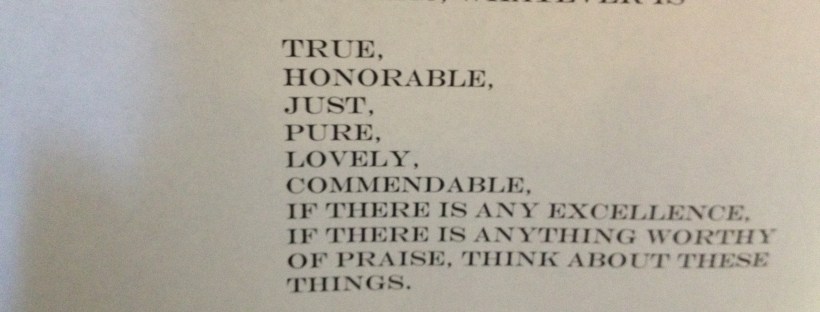
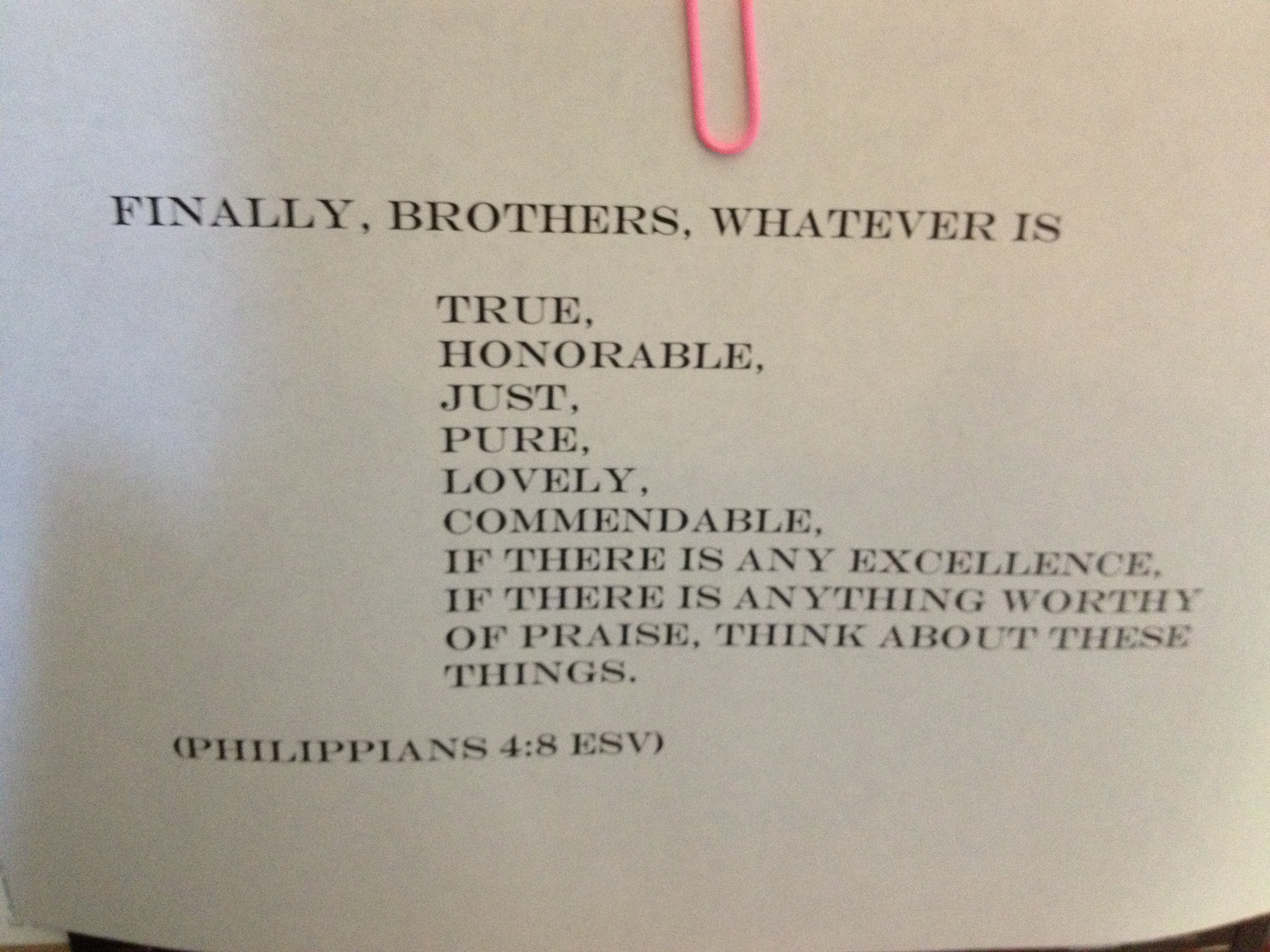
I have been trying to memorize Scripture this summer and am working on Philippians 4:8. Paul lays it out there pretty clearly about how to change our “stinkin’ thinkin’” into thinking godly thinking.

Brothers – think about whatever is:

True
Honorable
Just
Pure
Lovely
Commendable
Excellent
Praiseworthy

THINK ON THOSE THINGS. Hmmm.  So one of my projects is to do a word study on those qualities and in the process I am asking the Holy Spirit to help me think on those things – in my marriage – with my kids – with my co-workers.

Hey – what are you thinking about? Are you stuck in the stinkin’ thinkin’ mode? Then why not join me in thinking about and on the right things. Let’s do it together.

Running the race with joy,

Bill Welte
President/CEO

Daily Bible Reading: Psalm 31-32; Acts 16:1-21

Quote of the day: When the soul is plunged into the fire of divine love, like iron it first loses its blackness, and then growing to white heat, it becomes like unto the fire itself. Author Unknown

Verse to Memorize: With my whole heart I cry; answer me, O Lord! I will keep your statutes, I call to you; save me, that I may observe your testimonies. Psalm 119:145-146 ESV

…to the 4th Power The Scientific Skeptic

…to the 4th Power The Scientific Skeptic

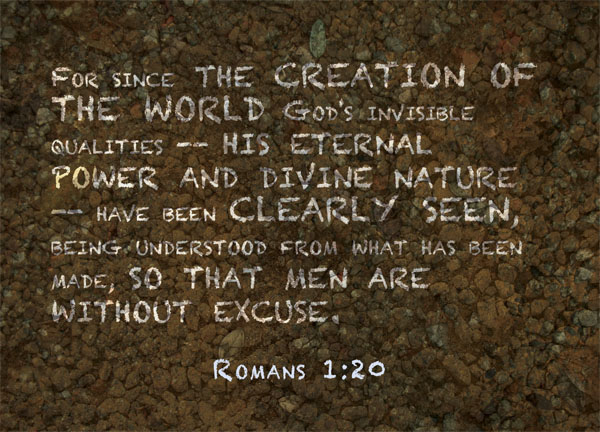
 “For His invisible attributes, namely, His eternal power and divine nature, have been clearly perceived, ever since the creation of the world, in the things that have been made. So they are without excuse.” Romans 1:20 (ESV)

When it comes to comparing the apples to the oranges we as Christian’s can agree with the Big Bang theory. God spoke and then…BANG!!! There was light. None the matter about an old earth verses a new earth, we Christian’s agree that God created everything around us. It really goes like this, “The earth was without form and void, and darkness was over the face of the deep. And the Spirit of God was hovering over the face of the waters. And God said, “Let there be light,” and there was light.” You can almost hear Moses go “’nough said there” as he was inspired to pen the first few verses of Genesis.

romans1-20


But not for those other folks they want to change the order of a divine beginning with some cosmic magic and star dust. First there was a hot, dense concentration of stuff that went boom. Then the stars came and then Mr. and Mrs. Star had a son and they named him Sun. Then the earth formed from stuff that was floating around with no sense of purpose and then comets crashed into the earth and then made water. And then somewhere in a galaxy far, far away Duck Dodgers of the 21st ½ Century traveled with his Ancient Alien friends and left them strand on the earth and we call their descendants…the human race!!

Pretty creative stuff there huh? But really the root of the problem is the worldview of Naturalism, where the source of the universe and of life is physical stuff without the supernatural cause being involved at all. Bill Foster gives us this explanation of Naturalism. “Naturalism tries to separate faith from reason by claiming that: 1) Religious faith is not supported by reason and science, and 2) Science does not rely on faith at all.” He also gives three reasons why naturalism is embraced by skeptics.

1) Nature makes no moral demands. It is easier to credit it as the source for everything rather being held accountable by YHVH. 2) Fear of the stigma of creationism. The Genesis account seems childish to a culture that accepts evolution as fact. He also mentions that there has been a settling of the sides for a God-guided evolution. Hmm… 3) Naturalism stems from intellectualism. They’re intellectually flat and simplistic (“God did it”) and creationism and Intelligent Design are like a cop-out for them.

Really the question that should be getting asked when we engage the scientific skeptic is “how much faith is required for that belief?” As Bill Foster stated in his book “Meet the Skeptic”…”We need to point out that faith is as central to the scientific skeptic’s worldview as it is to ours. The real argument is not faith versus science but rather, informed faith versus blind faith. Everyone relies on faith, physicist and preacher alike; the hypocrisy is pretending that you don’t.” I hope you stay tuned for the next category of skepticism. – Chris Hughes is a graduate of the Colony of Mercy and blogs regularly for Freedom Fighter

Daily Bible Reading: Psalm 23-25; Acts 14

Quote of the day: “We have two choices: believe the absurd or believe in the unseen.”—Bill Foster

Verse to Memorize: Your promise is well tried and your servant loves it. I am small and despised, yet I do not forget your precepts. Psalm 119:140-141 ESV
… to the 4th Power

…to the 4th Power!

Opening Statement

“To whom shall I speak and give warning, that they may hear? Behold, their ears are uncircumcised, they cannot listen; behold, the word of the Lord is to them an object of scorn; they take no pleasure in it.” Jeremiah 6:10 (ESV)

They make these statements whenever God becomes part of the discussion. “C’mon, you don’t believe that virgin birth stuff, do you?” “I think the Bible is full of myths and errors.” “Ya know, religion is the cause of most of the world’s problems.” Or the one that walks the offended road, “How can you say that your values are any better than anyone else’s?” These are the statements of someone who rejects the Biblical worldview in favor of a worldview that’s more fitting to suit their needs. We call this someone “The Skeptic!!” (Dun-dun-dun…needed to add that musical interlude)

1539_The-way-truth-and-life-art-628x300

American Heritage defines them like this…”One who instinctively or habitually doubts, questions, or disagrees with assertions or generally accepted conclusions.” Now if we were to pull that apart we might find a person who doesn’t want to be accountable to anybody for anything. But with words like “instinctively” and “habitually” placed in the framework of religious skepticism we can see a person in need of truth. And let’s face it, the world today is flat out hostile to the Gospel Truth, so to even squeak out “I’m Christian” can lead to ridicule. One might want to find the proof in the pudding, if you will, before realizing that Jesus is The Way, The Truth and The Life.

So what ingredients do we wrestle with as we dive into this pudding? Well there is the ever so everyday scientific one. We have the Biblical and Spiritual ones that get a good working over. But we have an ingredient that never seems to remain settled and that one is, in my opinion, the most difficult to work with and that one is the issue of morals. The science world is now trying to justify itself by aligning its truth with Biblical history. TV is now advertising that all spiritual roads lead to heaven and is using a Bible verse here and there to support its self. But the moral issue debates its self in the court of man and that’s where its failure begins, simply by throwing the Word of God outta the building.

So what are you to do Christian when it’s your time to face them? Well in his curriculum, “Meet The Skeptic”, Bill Foster simply advises us not to get overwhelmed. There are ways to deal with them as an apologist who wouldn’t come off as a 16th century theologian trying to fear the masses into church simply because they have lost their moral compass. (Which by the way isn’t really a bad idea) but to deal with them in a way that has them surrender (bad word here?) their lives over to Christ. We need to make our faith relevant; we need to test the words they say and to respond in a language that they can understand.

Basically as Paul would say, “I have become all things to all people, that by all means I might save some.” (1Cor 9:22b) Over my next few Freedom Fighters I would like to share with you those four areas of skepticism that face a Christian on an everyday basis either boldly or subtly. We are in time where truth is being argued in the wrong arena. We have allowed our society to pick and choose what works for them as a way of Good Orderly Direction and we are doomed for failure if we stand by idly and do nothing. Lets see what YHVH has for us to battle “The Skeptic”!! (Dun-dun-dun…had to do that just one last time) – Chris Hughes blogs regularly on Freedom Fighter and is a graduate of the Colony of Mercy

Daily Bible Reading: Psalm 20-22; Acts 13:26-52

Quote of the day: “Answering objections should not be our primary concern; we should recognize and engage the worldviews feeding those objections.”—Bill Foster

Verse to Memorize: Your promise is well tried and your servant loves it. I am small and despised, yet I do not forget your precepts. Psalm 119:140-141 ESV
Pursuing our Destiny — #9 — The Discipline of Fasting

Pursuing Our Destiny, Part 9—The Discipline of Fasting

But I discipline my body and keep it under control, lest after preaching to others I myself should be disqualified (1 Corinthians 9:27, ESV).

In speaking of the discipline of fasting, Tony Jones writes: I hate fasting.  No, seriously, I hate it, and I avoid it all costs.  It is my least favorite of the disciplines in this book. I wish I didn’t have to write about it.  I wish it weren’t so deeply rooted in the history of God’s people.  Then I could ignore it. (The Sacred Way, by Tony Jones)

6a00e54ecc070b8833017d40805149970c-800wi

In my experience, many Christians talk about fasting, but I’ve known very few who practice it.  And, I confess that my practice of this discipline has been hit and miss through the years.  Reading about and thinking about fasting to prepare for this article has reminded me how important fasting is and how much it needs to be a part of my regular spiritual practices.

Let me remind you.  We don’t pursue these spiritual practices for the fun of it.  Our goal is to experience transformation so that our lives more and more look like the life of Jesus.  Our God-ordained destiny, according to Romans 8:29, is to be conformed to the image of his Son, Jesus.  The practices of Jesus become the spiritual practices of our lives so that his life may become our lives.

So, back to fasting.  Thomas a Kempis wrote centuries ago about fasting: Arm yourself manfully against the wickedness of the devil; control the appetite, and you will more easily control all bodily desires.  We most often think about fasting as abstinence of food, and that’s the way we most often see it used in Scripture.  The Renovare Spiritual Formation Bible defines fasting like this: The voluntary abstention from an otherwise normal function—most often eating—for the sake of intense spiritual activity.

Fasting has several benefits.  In the context of Paul’s words at the opening of this piece, abstaining from food helps build self-control.  We tell our bodily desires that they don’t control us; we control them (in and by the power of the Holy Spirit).  Since we live in a world that is out of control, taking steps to avoid being pressed into the world’s mold (Romans 12:2) is always good for us.  Abstinence also benefits our spiritual growth by making us more sensitive to God’s work in our lives.  While we experience the want of going without, the practice of fasting attunes us to our dependence upon God.  That’s what Jesus experienced while fasting for 40 days in the wilderness.

Even if you’re not an over-eater, choosing to do without for the purpose of drawing nearer to God and becoming more like Jesus is still a good practice.  The practice can carry over to other appetites—especially if they seem out of control.  Money.  Sex.  The Internet.  Anything that controls you in any way can best be overcome by choosing to abstain from it for some period of time.

This is a practice to begin with care.  If health issues might be a problem, talk to your doctor first.  You may want to start with fasting for one meal.  Acclimate your body a bit and then fast for two meals.  Eventually, finding a day to fast regularly will benefit your transformation.  As best you can, use the time not invested in eating for prayer, time in God’s Word, or combine your fast times with silence and solitude.

Please don’t forget.  It’s all about becoming more and more like Jesus! – Pastor Strain blogs weekly on Freedom Fighter

Daily Bible Reading: Psalm 18-19; Acts 13:1-25

Quote of the day: A good character is the best tombstone. Those who loved you, and were helped by you, will remember you. So carve you name on hearts, and not on marble. Charles Haddon Spurgeon

Verse to Memorize: Your promise is well tried and your servant loves it. I am small and despised, yet I do not forget your precepts. Psalm 119:140-141 ESV
 

Esther — Real men make a difference

Esther — Real men make a difference

Did you ever stop to think how much easier it would be if you were single again? No wife. No kids.  Just you and the dog. What a cake walk! That’s where Mordecai was at when Esther’s parents died. But he was a Godly man—a stand up and deliver guy. He adopted his niece and raised her to be a God fearing woman who loved and respected her uncle and even more— God.

He was an encourager. When Esther was called to the king to be considered as queen, Mordecai was always at the gate waiting to hear how she was doing so he could help her in any way he could. He gave her advice and was available if she needed him. He sacrificed his time and pleasure to help Esther in difficult times.

Book-of-Esther-Feast-of-Purim

He was an example of Godliness. Mordecai would not compromise his beliefs and bow down to a man. (Haman). He risked death rather than do what was expected of him by men. It was faith lived out in the face of danger.

He encouraged Esther to stand up for her people and her God—even if it risked death. He had earned the right to do so by his own example and Esther—because of the faith she was raised with and by the example of Mordecai—took a huge risk based on faith.

He was an honored man. Mordecai had exposed a plan to assassinate the king and looked for nothing in return. But God, who forgets nothing, brought his good deeds to the kings attention at exactly the right time—a time when it not only saved his life from a murder plot by Haman, but allowed him to be empowered to save Gods people.

So here’s the big question—where are we at as men in our lives today? Are we going out of our way to make a difference for the Lord or are we going out of our way to avoid responsibilities and difficulties? Married or single, does the Lord really matter most in your life? – Steve Schmidt is a graduate of the Colony of Mercy and serves on the full-time ministry team at America’s Keswick

Daily Bible Reading: Psalm 16-17; Acts 12

Quote of the day: The will of God is found in the Word of God. The more a person grows, the more he begins to think instinctively and habitually from a divine perspective. Howard G. Hendricks

Verse to Memorize: Your promise is well tried and your servant loves it. I am small and despised, yet I do not forget your precepts. Psalm 119:140-141 ESV
History Repeats Itself

History Repeats Itself

For the past 25 plus years the ministry of America’s Keswick has been prayerfully considering starting a residential women’s ministry similar to the Colony of Mercy.

We actually went out and dedicated a piece of property that we believed could be the place where we could build the facility. But God has never fully opened the doors. At every turn there were significant roadblocks.

Our Board has agonized over the women’s ministry in prayer and two years ago we moved it to the front burner of our agenda trusting that if He was in it – we were willing to listen and be obedient to His leading.

Friday, July 12th was one of those milestone days in the life of our ministry. The Board of Trustees voted to officially begin the residential women’s ministry using the home of Pastor Bill and Ruth Raws, the grandson of our founder.

IMG_6500

115 years ago, William Raws, our founder, gathered his staff and at the old homestead on our campus, gathered together after a Bible study, and with a little pump organ, stood together and sang, “All hail the power of Jesus’ name!”

Well on Friday our Board gathered at the Raws Home and after a season of praise and prayer, the Board lifted their voices in praise and sang, “All hail the power of Jesus’ name.” It was one of the most special times in my 17 years of ministry at America’s Keswick.

The ministry is so needed today. Women are battling addiction and they need to know that Jesus Christ wants to set them free.

The ministry will be named “Barbara’s Place” in honor of the wife of our Board Chairman, Howard and Barbara Bateman.

Why do I tell you all this? Because God not only has been faithful to our ministry BUT He still is faithful. And that gives us reason to trust and believe that He WILL BE in the future if we trust Him.

Yes, history does often repeat itself. But I am thankful today that He continue to write HIStory! And it is downright exciting to be part of it.

Running the race with joy,

Bill Welte
President/CEO of America’s Keswick

Daily Bible Reading: Psalm 13-15; Acts 11

Quote of the day: A man’s life is always more forcible than his speech. When men take stock of him they reckon his deeds as dollars and his words as pennies. If his life and doctrine disagree, the mass of on-lookers accept his practice and reject his preaching. Charles Haddon Spurgeon

Verse to Memorize: Your promise is well tried and your servant loves it. I am small and despised, yet I do not forget your precepts. Psalm 119:140-141 ESV

Accountablity

Accountability

Joshua 7

As I was reading Joshua, I was struck with a big question—how did Akin get away with hauling all that treasure back to camp and no one saw him? How could he do that? Several thousand men and no one saw him—or did no one have the guts to challenge him, to hold him accountable.

Accountability

“7- But the Israelites were unfaithful”  This gives the distinct impression that more than one person knew what was going on, that they let Akin walk in his sin. The consequences of his sin were very evident the next time they went to battle against Ai. They got their butts kicked. God was not on their side. By the time God spoke to Joshua and they worked all the way through the tribes to Akin, the consequences were severe.

It would also appear that Akins family knew what he had done but did nothing to make things right either as they were put to death with him.

I know how this works, how to avoid accountability. I tried to hide my sin and did—for a season. You can hide from people or try to intimidate them. Some use sweetness and others, a laugh. We know people who are struggling with sin and yet, for some reason we are just too afraid to confront them. We are afraid of what they will say or how they will act and we simply avoid the issue. But God doesn’t let sin go unaddressed forever. We have seen many men who have lost money, jobs, families—even their lives because they were not held accountable for their actions. Perhaps we have experienced some of these consequences ourselves and in hind sight, we wish someone had stepped into our lives before we “hit the wall”.

Who do you know that is struggling with sin and needs accountability?  What “fears” are stopping you from speaking the truth in love to a brother in need? What “defenses” are we using to stop accountability?

Lord, let me pray Joshua 1:9 and then, help my brother! Amen – Steve Schmidt is a graduate of the Colony of Mercy and a Freedom Fighter blogger

Daily Bible Reading: Psalm 1-3; Acts 9:22-43

Quote of the day: If a man cannot be a Christian in the place where he is, he cannot be a Christian anywhere. Henry Ward Beecher

Verse to Memorize: Righteous are you, O Lord, and right are your rules. You have appointed your testimonies in righteousness and in all faithfulness. Psalm 119:137-138 ESV